Review of AFRINIC Policy Development Process
The PDP in use at AFRINIC celebrates its 15 years anniversary this November 2025. It served to elaborate many policies, but all attempts to either update it or improve it to cope with the changes and evolutions have failed.
As the African Internet community begins the journey to restore AFRINIC, it is important for the community to reflect on the Policy Development Process, which organizes discussions and adoption of policies that govern the management of number resources in the region.
This document is not a policy proposal, but a review and thoughts about how to evolve the PDP. It meant to create an understanding and stimulate discussions.
1- AFRINIC PDP framework
The framework is structured from ICP-2 and the bylaws to the Policy Development Process.
a- AFRINIC bylaws
Below are the relevant sections.
1) Interpretation
[9] Community Meeting: Community Meetings shall include the Public Policy Meetings and the Annual General Members’ Meeting provided for in terms of Section 115 of the Act, or any special meetings of the members.
[17] Internet community:Any person or corporate body living or operating in the AFRINIC service region and interested in Internet Number Resource Management.
[23] Policy Development Process (PDP):A bottom-up, open, and transparent process, approved by the Internet Community, wherein all stakeholders may participate in the creation of policies that would ensure that the Internet Number Resources are distributed and managed responsibly and fairly.
11) Community meetings
Community Meetings shall include the Public Policy Meetings and the Annual General Members’ Meeting provided for in terms of Section 115 of the Act, or any special meetings of the members.
11.1 The Board shall call an Annual General Member Meeting in terms of Section 115 of the Act:
i. not more than once in each year;
ii. not later than six (6) months after the balance sheet date of the Company; and
iii. not later than fifteen (15) months after the previous Annual General Member meeting.
11.2 The Board shall call a Public Policy Meeting at least once a year as per requirements defined in the Policy Development Process. Public Policy Meeting may be attended by:
members (Registered, Resources, and Associate);
Anyone interested in the Number Resources Management policy.
11.3 For the purpose of subsection 11.2, a Public Policy Meeting means a meeting open to the community wherein proposals for policies for a proper and responsible usage and Management of Internet number resources are discussed and agreed upon within the framework of the Policy Development Process (PDP) defined by the Regional Internet community and ratified by the Board.
11.4 Notwithstanding the provisions of Article 11.3 above, the Board may adopt such policies regarding the management of Internet number resources where it considers that the same is necessary and urgent, having regard to the proper and responsible usage of these resources.
11.5 Endorsement of the policy adopted by the Board:
i. Any policy adopted by the Board under the provisions of Article 11.4 shall be submitted to the community for endorsement at the next public policy meeting.
ii. In the event that such a policy submitted by the Board is not endorsed, the said policy shall not be enforced or implemented following its non-endorsement; however, any action taken in terms of the policy prior to such non-endorsement shall remain valid.
b- AFRINIC PDP
The current Policy Development Process has been enforced since 11/11/2010. It is based on a Policy Development Working Group (PDWG) led by 2 co-chairs and a process for policy development. It provides mechanisms for variation of the normal process and for dispute resolution.
The PDP requires the following instances:
- Public Policy Meeting: The Board shall call a Public Policy Meeting at least once a year as per requirements defined in the Policy Development Process. Public Policy Meeting may be attended by:
- members (Registered, Resources, and Associate);
- Anyone interested in the Number Resources Management policy.
- Co-chairs: Elected by the community during the public policy meeting
- Appeal Committee: appointed by the board
- Recall Committee: appointed by the board
- Staff: Analyses and policy’s implementation
- Board: Policy proposal’s ratification
A flowchart of the current PDP is presented below.

Fig1: AFRINIC PDP Flowchart – Source: AFRINIC
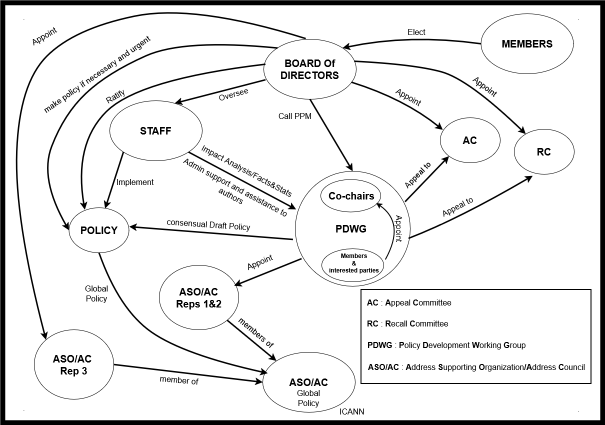
Fig2: Representation of the current AFRINIC PDP
2- Impacts of the Frozen AFRINIC Board on PDP
The lack of a board quorum had many negative impacts:
- Adopted policy proposals not ratified or not implemented
- No PPM
- Non-renewal of co-chairs
- Non-renewal of appeal and recall committees
- Non-renewal of community ASO AC representatives
- Inactive Resource Policy Discussion mailing list, since August 2022
3- Motivations for a better and resilient PDP
ICP-2 and the new RIR governance document (work in progress) require, as an ongoing commitment, that each RIR maintains an open, transparent, well-documented PDP and holds at least one annual policy meeting open to all interested parties.
The Implementation and Assessment Procedures for ICP-2 Compliance adopted by the ICANN board through the resolution 2024.12.24.01 allows RIR-Initiated and ICANN-Initiated ICP-2 Compliance Reviews.
The last AFRINIC PPM was held on 01 & 02 June 2022 during AFRINIC-35. AFRINIC has not had a public policy meeting in 2023 and 2024.
In case of emergency, the RIR services are expected to be run by an emergency registry operator, and in case of derecognition, a successor RIR be designated. It is unclear how the RIR PDP will accompany these changes.
The current PDP was an important improvement of the initial PDP, but was adopted at a time when the AFRINIC community was still maturing, engaging, and so board-centric.
Based on the above, it is important and urgent to discuss the details for a new PDP, which:
- is more community driven and governed
- maintains continuity irrespective of the Registry Service Operator
- guarantees that the AFRINIC Internet Community will always continue to define the policies to govern Number Resources management in AFRICA
4- Possible Solutions
One possible solution to the problem presented above is described below. It aims to upgrade the current process to a resilient, self-governed, community-oriented PDP which enables active participation of all interested parties. It includes, among other things, the possibility for the PDWG co-chairs to call Community consultation meetings to present, discuss, and raise awareness on policy proposals in various constituencies, various languages and also the provision to ratify policy proposals by petition if the board is unable or fails to ratify proposal without valid reasons or for not providing a reason at all.
The new variants in bold.
- Community consultation meeting on policy proposals and related matters (CC)
- PPM (policies are discussed, and consensus may be sought)
- CC can be called anytime for co-chairs
- PPM is called at least once a year by the NC (Number Council)
- Co-chairs appointed during PPM
- ASO AC community representatives appointed at PPM
- NC is composed of the 3 ASO AC representatives and co-chairs. NC is chaired by one of the Community-appointed ASO AC
- ASO AC community representatives and the immediate past co-chair served as the appeal/recall committee
- PDWG defines a mechanism to appoint co-chairs and interim co-chairs
- PDWG defines a mechanism to appoint ASO AC community representatives and interims
- If a policy proposal fails to be ratified by the board (inability or refusal by the board without reasons for 60days), a petition for ratification can be initiated by a member of the PDWG.
- If the petition is supported by at least 15 members of the PDWG who are:
- registered contacts of distinct members in AFRINIC WHOIS database
- from at least 3 AFRINIC sub-regions
- Staff and legal evaluation of the proposal must be conducted
- And if no objection from staff and legal, the proposal must be considered ratified and implemented by staff
The diagram below presents the role of each of the instances in the new PDP model
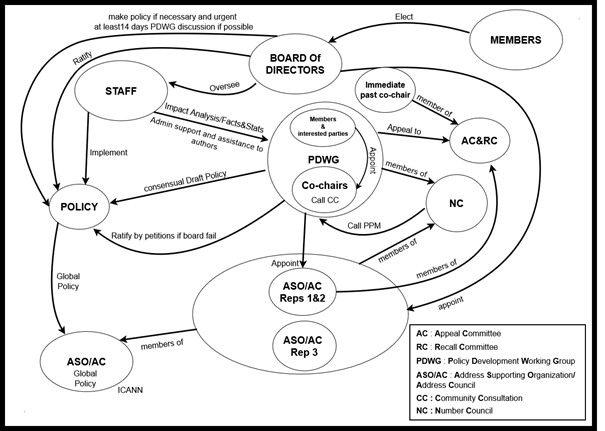
Fig3: Representation of a new PDP model
Author: Adeola A. P. AINA
Date: 06/12/2025